
“Few are guilty, but all are responsible,” Rabbi Abraham Joshua Heschel declared at the National Conference on Religion and Race in January 1963. He spoke to more than sixty Catholic, Protestant and Jewish denominations gathered in Chicago to confront racial segregation through interfaith cooperation. Among the speakers was the Rev. Dr. Martin Luther King Jr., who met Heschel there for the first time. The meeting marked the beginning of a relationship that would soon extend from sermons to the streets of the Civil Rights Movement.

King arrived at the conference already carrying national recognition within the Civil Rights Movement. He was a Baptist minister, educated at Morehouse College, Crozer Theological Seminary and Boston University. King first drew national attention during the 1955-56 Montgomery Bus Boycott. Under his leadership, the protest lasted for over a year and ultimately led to a Supreme Court ruling declaring bus segregation unconstitutional.
By the early 1960s, King had come to frame civil rights through religion, drawing from Christian teachings on love and justice. In “Letter from a Birmingham Jail,” he wrote that “we are caught in an inescapable network of mutuality, tied in a single garment of destiny,” expressing his commitment that injustice to anyone is injustice to everyone. The line reflected his view that injustice imposed obligations beyond any single community.
Like King, Rabbi Abraham Joshua Heschel arrived in Chicago with a reputation of his own. Born in Warsaw and raised in a Hasidic tradition, he immigrated to the U.S. in the late 1930s and later taught at the Jewish Theological Seminary in New York. He wrote often on themes of human interdependence and moral sensitivity. By the early 1960s, he was known for his theological writings on human responsibility and spiritual sensitivity.
In his first work, “Man Is Not Alone,” he wrote that “we are not self-sufficient. We are in need of each other.” In “God in Search of Man,” he described “the truly pious man” as one “sensitive to the suffering of others.” Both works emphasized interdependence as an obligation. When Heschel addressed the Chicago conference, he carried that language of shared responsibility, now focused on racial injustice.
Two years after their meeting in Chicago, King and Heschel appeared together again during the Selma to Montgomery Marches of March 1965. The demonstrations were organized to demand federal protection of voting rights in Alabama.
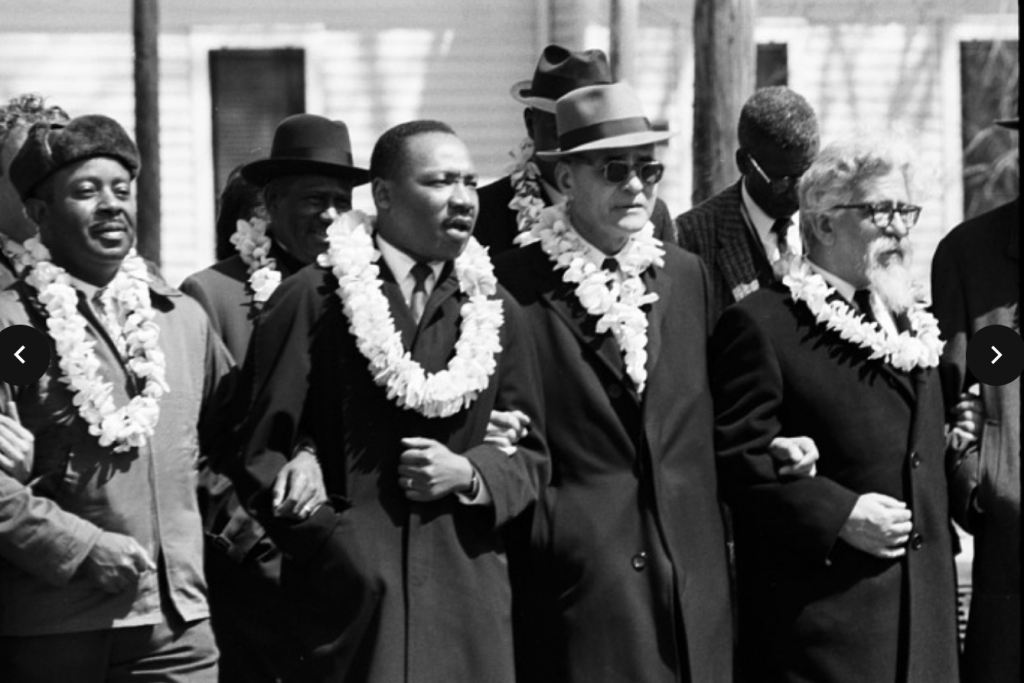
On March 7, later known as “Bloody Sunday,” state troopers attacked peaceful demonstrators as they crossed the Edmund Pettus Bridge. In the days that followed, religious leaders from across the country traveled to Selma. King and Heschel walked arm in arm during the later successful march to Montgomery.
Photographs from the marches show rabbis, priests and ministers marching together, reflecting the interfaith cooperation that King and Heschel encouraged in their writings. Heschel later described the experience by saying, “I felt my legs were praying,” linking the act of marching with religious devotion. Selma became a visible moment where the religious language of both men appeared in their shared public action.

After Selma, King and Heschel continued to appear in many of the same religious and public spaces. Both leaders expanded their work from civil rights to include opposition to the Vietnam War.
Heschel was a founding member of Clergy and Laity Concerned About Vietnam (CALCAV), an interfaith organization of religious leaders opposing the war. In April 1967, CALCAV sponsored the event at Riverside Church in New York, where King delivered his speech “Beyond Vietnam: A Time to Break Silence.” In that address, he told the audience that “every nation must now develop an overriding loyalty to mankind as a whole.” The language broadened the scope of responsibility beyond race and national borders.
They appeared together again in March 1968 at the Rabbinical Assembly convention, where Heschel introduced King for his speech to the forum of Conservative rabbis. In his introduction, Heschel warned that “the situation of current America is our plight… To be deaf to their cry is to condemn ourselves.” Joint appearances marked their continued association in religious public life. Their relationship continued until King’s death in 1968.

King was assassinated on April 4, 1968. Heschel traveled to Atlanta to attend the funeral and delivered a memorial address honoring King’s life and work. His speech marked the closing of a partnership that had been visible in Selma and their work opposing the Vietnam War.
The broader Black-Jewish collaboration of the civil rights era continued through institutional efforts. The Anti-Defamation League, a Jewish civil rights organization, continued lobbying with Black organizations for civil rights legislation and fair housing initiatives in the late 1960s. Their involvement had begun during earlier campaigns for desegregation and voting rights. At the same time, cooperation persisted at the grassroots level. The Student Nonviolent Coordinating Committee (SNCC), a student-led organization for voter registration and campaigning, collaborated with Jewish volunteers for voter registration drives in the South. Though the political climate was shifting, connections formed during the height of the movement continued to organize and advocate across communities.
That cooperation unfolded within a changing political landscape, and this introduced challenges. In 1968, the Ocean Hill-Brownsville school conflict publicized disputes over community control of schools. The controversy involved largely Black community activists and a teachers’ union whose membership included many Jewish educators. What had once been a partnership in joint marches and campaigns now surfaced in debates over local authority, labor rights and educational control.
King’s assassination marked the close of a period in which he and figures such as Heschel had stood together in nationally visible movements. The years that followed did not erase earlier collaboration, but introduced new tensions that reshaped how Black and Jewish communities encountered one another in public life.
In the decades that followed, cooperation did not disappear, though its form changed. In the 1980s and 1990s, initiatives such as the Foundation for Ethnic Understanding brought Black church leaders and Jewish clergy together for structured dialogue and joint programming. Participants often referenced the civil rights era as a point of origin for the partnerships.
More recently, moments of crisis have again drawn the communities into public solidarity. After the 2018 shooting at the Tree of Life synagogue in Pittsburgh, Black clergy and civil rights leaders attended memorial services and issued condemnation statements. Two years later, following the murder of George Floyd, Jewish organizations supported racial justice reforms and joined interfaith coalitions addressing police brutality. These responses reflected the pattern of communities speaking beyond their own constituency in moments of violence, crossing boundaries in solidarity.
The relationship between King and Heschel remains part of that history. Their appearances together did not eliminate disagreement or prevent later tensions, but offered a visible example of how religious language could shape public alliances across differences. When they walked side by side in Selma or addressed audiences in Chicago and New York, they framed injustice as a shared burden across communities. That approach continues to reappear, in different contexts, when communities respond to injustice beyond their own boundaries. While King and Heschel’s example does not offer easy answers, it invites the possibility of standing together.
Noam Schochet is a rising third-year student at the University of Florida on the pre-law track, studying political science with an interest in international relations. He spends his free time watching Gators sports, reading fantasy novels and wrestling with his beagle Beauford.
Next Article: Jewish Solidarity and the Israeli Black Panthers>>